
Insights | 23 November 2026
Finance hiring got harder in 2026. Start your 2027 hires before December.
Three trends from 2026, and what they mean for when your next hire starts.
South Africa's finance industry added 132,000 jobs in the year to September, according to Stats SA's Quarterly Labour Force Survey. Over the same year the economy as a whole lost 215,000. Experienced finance people became the most contested hires in the country in 2026, candidates started judging offers on what reaches the bank, and tech employers found themselves up against overseas companies for people who never leave home. Each of these makes a hire briefed in January slower than most 2027 plans assume.
Finance added four times as many jobs as any other industry
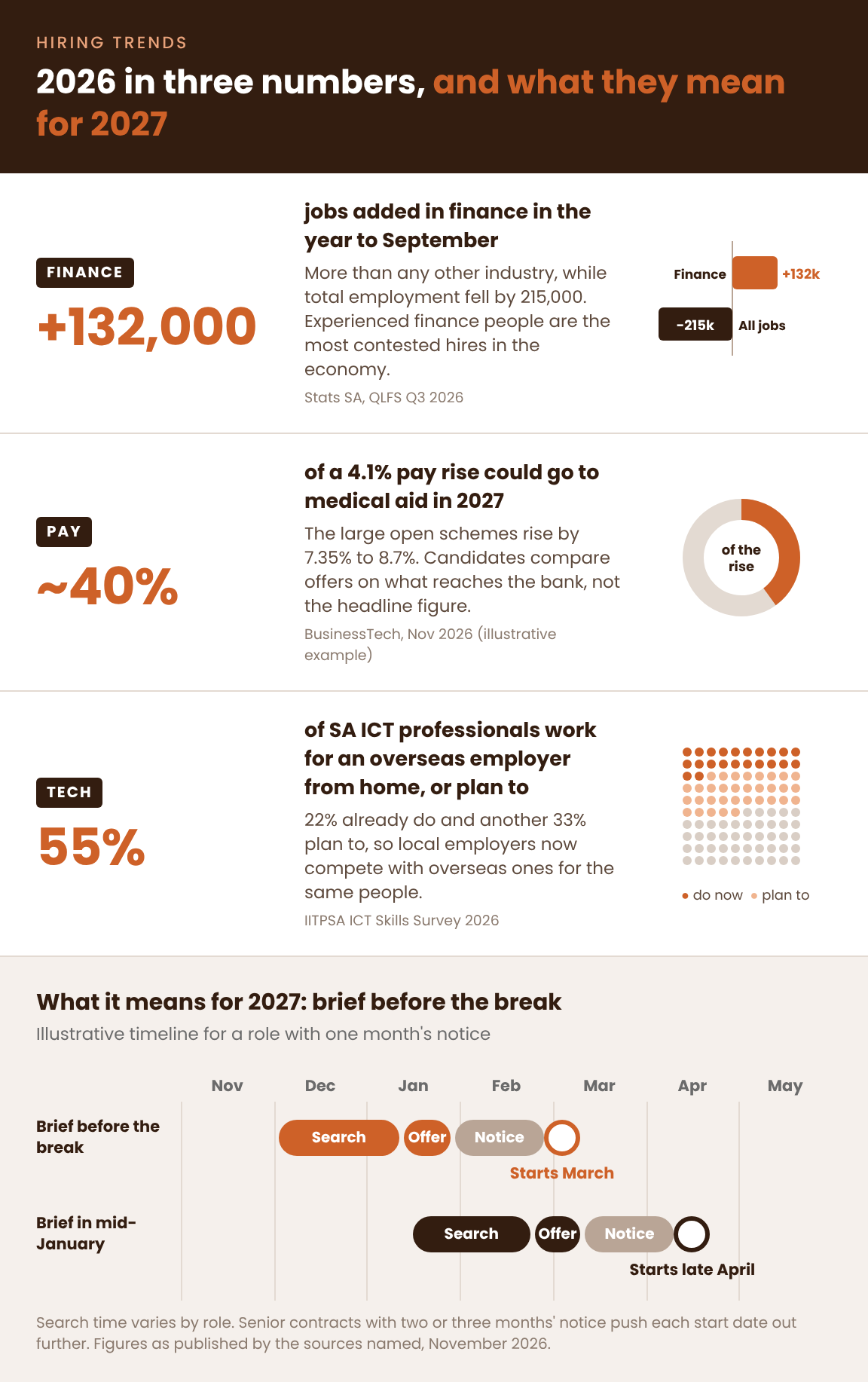
Finance added 132,000 jobs in the year to September, about four times as many as mining (32,000), the next strongest industry, while community and social services lost 197,000 and total employment fell by 215,000 to 16.8 million. The third quarter alone was stronger still, with finance adding 111,000 jobs when the economy as a whole added 101,000 between the second and third quarters. Stats SA's finance category includes business services, so not every one of these jobs belongs to an accountant, yet the demand for finance and business skills is clear. A company looking for a financial controller or a finance manager in 2027 is competing with the one part of the economy that is growing, and its search is likely to take longer than the budget allows.
Medical aid will take about 40% of an average raise in 2027
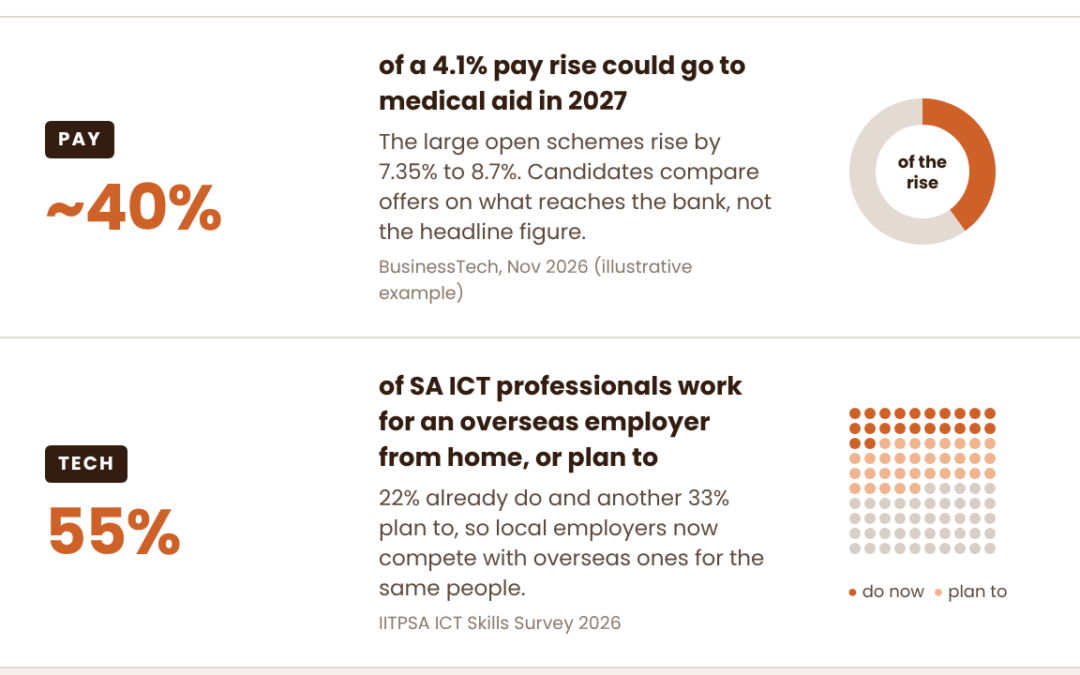
The large open medical schemes will raise contributions by between 7.35% (Bestmed) and 8.7% (Bonitas) in 2027, as reported by BusinessTech. Discovery sits at 8.2% and Momentum at 7.9%. In an example from Efficient Wealth, a household taking home R30,000 a month with a R6,000 contribution gets a 4.1% increase, which adds R1,230. An 8% rise in the contribution costs R480 of that, or about 39%, which leaves R750 for everything else. Candidates do this sum before they accept, so an offer that sets out take-home pay after benefits is easier to accept than one that quotes only the cost to company.
Where the job sits counts as much as what it pays. This quarter two senior finance candidates I spoke to turned down a strong role abroad to stay closer to home. Pay brings a candidate to the table, and where the job sits decides whether the offer works for the rest of their life.
More than half of South African ICT professionals work for overseas employers or plan to
According to the IITPSA's 2026 ICT Skills Survey, 22% of South African ICT practitioners already work remotely for an international employer (CIO Africa). Another 33% plan to. The survey was released at the IITPSA Workforce Intelligence Conference on 30 October. That puts 55% of the profession either working for an overseas company from home or planning to. A South African telecom or IT employer making an offer in 2027 is competing with the pay and flexibility of a company abroad, and the candidate can take that offer without packing a bag.
A role briefed in mid-January rarely starts before late April
Hiring plans usually start in January, when budgets are signed off and managers are back at their desks. January is also when people decide to move, because bonuses and 13th cheques are paid in December, the holiday gives them time to think, and resignations tend to follow in the first weeks of the year. The Basic Conditions of Employment Act sets a minimum of four weeks' notice for anyone employed for more than a year, and senior contracts commonly ask for two or three months.
The working is short. A role briefed in mid-January, with about six weeks of search and interviews, reaches an offer in early March, and a month's notice after that puts the new person at their desk in late April at the earliest. On three months' notice the start date moves to June, and half the year has gone. A search briefed before the break runs on a different clock, because the first conversations happen in December, interviews are held in early January while candidates are still weighing their options, and the new person can start in March.
The work that saves the most time happens before the office closes
Agreeing the brief and the budget in December means any gap between the pay and what good candidates expect shows up while there is still time to fix it. With medical aid rising about twice as fast as an average raise, that gap is likely to be wider in 2027. Holding first interviews online over the holidays, with decision-makers' leave dates agreed up front, stops a strong candidate waiting three weeks for an answer. A clear case for the move matters at the end, because a good candidate who resigns is likely to be offered more to stay. The employer who has explained the role, the team and the reasons to join is the one who keeps them.
Finance and tech talent will be at least as hard to hire in the first half of 2027 as it was in 2026. The employers who brief before December will be interviewing while the rest are still signing off budgets. Collier recruits finance, telecom and IT professionals across South Africa, and a brief agreed in December can become a shortlist in the first week of January.
Sources
- Stats SA, Quarterly Labour Force Survey, Q3 2026, as reported by BusinessTech and Business Day, 10 November 2026
- Medical scheme increases for 2027 and the Efficient Wealth example, BusinessTech, 12 November 2026
- IITPSA 2026 ICT Skills Survey (with Africa Analysis), as reported by CIO Africa, 3 November 2026
- Basic Conditions of Employment Act 75 of 1997, section 37
Tell us what you need.
Talk to a principal consultant about your next hire, or about building a team in South Africa.